Review Article | | Peer-Reviewed

Analysis of Economic Efficiency of Onion Production Under Irrigation in West Shewa Zone, Oromia, Ethiopia

Received: 24 June 2025     Accepted: 17 July 2025     Published: 18 August 2025
Views:       Downloads:
Abstract

The study was measures efficiencies of Onion Producers under irrigation and identify factors affecting them in in West Shewa Zone, Oromia, Ethiopia. Stochastic production frontier model was used to estimate technical, allocative and economic efficiency levels, whereas Tobit model was used to identify factors affecting efficiency levels. Accordingly, the mean technical, allocative and economic efficiencies of sample households were 74%, 70% and 52%, respectively. Land, seed, herbicide and insecticide, labor and oxen power were positively affected the production of onion. Although, land, seed, herbicide and insecticide were underutilized inputs but labor and oxen power were over-utilized inputs. Results of the Tobit model revealed that land allotted to onion production and credit utilization was affected technical efficiency positively but distance to the FTC was affected technical efficiency negatively. It also revealed that onion production experience, land allotted to onion production, pilot distance, distance to the market were affected allocative efficiency negatively but having own motor pump and extension contact were affected allocative efficiency positively. Besides, Family size, credit utilization and extension contact were positively affected economic efficiency of onion production but pilot distance and distance to the FTC were negatively affected economic efficiency of onion production. Results indicate that there is an opportunity to increase efficiency of onion production under irrigation in the study area. Therefore, zonal and district office of agriculture, stockholders and concerned bodies should focus above mentioned factors to improve the productivity of onion under irrigation.

Published in Science Research (Volume 13, Issue 4)
DOI 10.11648/j.sr.20251304.16
Page(s) 101-111
Creative Commons

This is an Open Access article, distributed under the terms of the Creative Commons Attribution 4.0 International License (http://creativecommons.org/licenses/by/4.0/), which permits unrestricted use, distribution and reproduction in any medium or format, provided the original work is properly cited.

Copyright

Copyright © The Author(s), 2025. Published by Science Publishing Group

Keywords

Cost, Determinants, Efficiency Measurement, Functional Form and Resource

1. Introduction
In Ethiopia, onion (Allium cepa L.) has produced throughout the year, unlike shallot and garlic, which is rain-fed, Onion produced under rain-fed conditions in the rainy season, and under irrigation in the dry season, is considered an important crop produced by small-scale farmers. The crop is produced in home gardens and commercially in different parts of the country. There a 734,921 onion holders in Ethiopia and they operate onion production under 36,373Ha and also onion yield 75 qt/ha . From production point of view, onion is comparatively easy to produce, provided it is grown in the dry season when diseases are less prevalent It is essentially produced by smallholder farmers as a source of income and it is believed to be more frequently consumed. The area under onion cultivation is increasing mainly due to its high profit per unit area and expansion of small-scale irrigation. Despite increased production area for onion; its productivity is lower than in other African countries. This is due to out of date farming techniques, lack of knowledge on the efficient utilization of available and limited use of modern agricultural technologies, out of date farming techniques, poor complementary services such as extension, credit, marketing, and infrastructure, poor and biased agricultural policies in developing countries like as Ethiopia .
Moreover, a review of the past research works by different scholars in different region of Ethiopia mainly focused on economic importance of onion Some scholars also focus on technical efficiency of male and female as irrigated onion . However, these studies did not address the economic efficiency onion production under irrigation by smallholder farmers. Given the economic importance of this crop, scientific search on economic efficiency and source efficiency in onion production under irrigation is over sighted. Regardless of significance the crop, empirical evidence about level of efficiencies and its determinants is missing. Specifically, in West shewa zone economic efficiency of small holder farmers in onion production with irrigation is not studied in anyway. To fill the existing knowledge gap this study was initiated with an objective of to estimate the level of technical, allocative and economic efficiencies of onion production under irrigation and to identify the determinants of technical, allocative and economic efficiencies of onion producers by irrigation in the study area.
2. Research Methodology
2.1. Data Types, Sources and Methods of Data Collection
Both primary and secondary data from different source will be used. Primary data was collected from selected producers from three district found in the zone and three kebeles from each district using pre-tested semi-structured questionnaire. Secondary data relevant for this study was gathered from Zonal and district irrigation Authority, published and unpublished materials.
2.2. Sampling Technique and Sample Size Determination
A purposive and three stages sampling method was used to draw appropriate sample. In the first stage, from zone three districts was selected purposively based onion production potential (irrigation better water and irrigable farm access, better volume of production and more number of producers). In the second stage, three kebele administrations (KAs) was selected purposively in the same way from each district. In the third stage, representative onion producers will randomly selected. Total sample size will obtain from the population through a sample size calculator using Yamane formula.
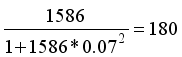
Accordingly, the required producers sample size at 95% confidence level with 7% level of precision, then the formula is given as:
n=
n= = (1)
Where n= the sample size, N= the population size of onion producers, and e= is the level of precision.
2.3. Methods of Data Analysis
Two types of data analysis, descriptive statistics and econometric analysis was employed to meet objectives of the study. For investigation of technical, allocative and economic efficiencies, stochastic frontier production function by using Cobb-Douglas production function was used after various test conducted. SFA model is specified in the following equation (2);
(2)
Whereas is yield of onion in kuntals, is a Cobb Douglas production, is input used and an error term, due to technical inefficiency and noise.
Technical efficiency of an individual firm is defined in terms of the ratio of the observed output (Y) to the corresponding frontier output (Y*), given the available technology, conditional on the levels of input used by the firm. Thus expressed as follows in equation (3)
Wherey*= (3)
is the highest predicted output for the ith farmer. The TE of the ith farm is expressed by the ratio of the observed production output to the highest predicted output (frontier output). Using a linear representation the empirical function to be estimated is written as in equation (4):
(4)
Where, subscript , indicates onion producers in the sample (i=1,..n), is the natural logarithm (i.e. logarithm to base e); are parameters (elasticities) to be estimated and is input used in production process, the parameters and represent the stochastic and inefficiency components of the error term respectively.

The stochastic frontier cost functions model for estimating farm level overall economic efficiency is specified as in equation (5):
)(5)
Where, represents total production cost, represents a suitable functional form, represents output produced, represents cost of input (labor, oxen, land, seed, fertilizer and others), represents parameters of cost function and represents the error terms.
The cost efficiency of an individual farm is defined in terms of the ratio of the observed cost (actual cost) (C) to the corresponding minimum cost (the frontier total production cost or the least total production cost level) (C*) given the available technology.
Thatis,costefficiency(CE)=
Thatis,costefficiency(CE)= (6)
Hence, following the adoption of Battese and Coelli (1995) framework for the analysis of the data, the stochastic frontier Cobb-Douglas cost function for onion production is specified as in equation (7):
(7)
Where Ci is total cost of production and Pij is price of input used in production.
Economic efficiency (EE) is computed as inverse of equation (6). Hence, farm-level economic efficiency (EE) is obtained in the following equation (8):
EF=1CE=C*C(8)
Where, C* is minimum cost and C is observed cost, Estimation of AE can be achieved through the use of efficiency results from TE and EE where EE is derived from the CE function. EE is the product of TE and AE. Hence, a measure of farm specific allocative efficiency (AE) is obtained from technical and economic efficiencies estimated as in equation (9);
(9)
The resource use efficiency parameter also calculated using equation below (10)
r=MVPMFC=MPP*PYPx=βxYX*PYPx
If r =1 resource was efficiently utilized, if r>1 resource is underutilized and if r<1 resource was underutilized.
2.4. Determinants of Efficiency
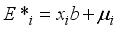
In this study, to identify the effect of independent variables on level of efficiencies, two-limit Tobit model was employed.
Because of the character of the dependent variable which is efficiency score that takes values between 0 and 1 the model is appropriate (Maddala, 1999). Following Maddala, the model was specified as, equation (10).
(10)
if and, if
Definition of variables for production and cost frontier analyses.
Table 1. Description of the variables used in parametric stochastic production and cost frontier analysis.

Variables

Variable description and measurement

Unit

Expected sign

Ln (land)

Natural log of farm land under onion production

Hectares

+/-

Ln (seed)

Natural log of the quantity of seed used in production

kilogram

+/-

Ln (fertilizer)

Natural log of the quantity of fertilizer used in Production

kiloggram

+/-

Ln (chemicals)

Natural log of the quantity pesticides and Insecticides used in production

literes

+/-

Ln (labor)

Natural log of family, exchange and hired labor used in Production

Man days

+/-

Ln (oxen)

Natural log of oxen used in plowing land

Oxen days

+/-

Ln (Ci)

Natural Log of the cost of onion production under irrigation

Birr

Ln (land)

Natural log of total rental price of land per hectare (Size of land * Price/hectare)

Birr

+

Ln (seed)

Natural log of the total price of seed (Kilograms * price/kg)

Birr

+

Ln (fertilizer)

Natural log of the total price of fertilizer

Birr

+

Ln (chemicals)

Natural log of total price of pesticides and insecticide

Birr

+

Ln (labor)

Natural log of the total price of labor during farming

Birr

+

Ln (oxen)

Natural log of rental value of of oxen per day

Birr

+

Table 2. Variables definition and hypothesis for sources of efficiency.

Variables

Variable description and measurement

Expected sign

Dependent variable

The dependent variables are technical, allocative or economic efficiency scores of smallholder onion producer under irrigation that take the values between 0 and 1

Independent variable

Age of HH measured in years

+/-

Onion production experience under irrigation measured in years

+/-

Family size measured in AER

+/-

Education of HH measured in formal schooling

+

Total livestock measured by TLU

+/-

Land allotted to onion production measured in hectare

+

Plot distance measured in minute

-

Distance to the nearest market measured in minute

-

Having Motor pump it is dummy variable wether HH have pamp or not

+

Credit utilization measured it dummy wether HH used or not a credit

+

Distance to Th e FTC measured in minute

-

Extension contact

+

3. Results
3.1. Descriptive Results
On average, the sampled households produced 30.75 qt of onion, which is the regressand variable in the production function. The land allocated for onion production, by sampled households during the survey period was ranged from 0.06 to 7.5 ha with an average of 0.312 ha. Similarly, on average the sampled farmers incurred 32,909.34 birr to produce 30.75 quintal of onion. Among the six factors of production, labour and the cost of land accounted the highest share 29.93%, 21.44% respectively (Table 1). The statistics of demographic, socioeconomic, farm and institutional variables which were expected to affect technical, allocative and economic efficiency levels of smallholder farmers in the study area are presented in Tables 2 and 3.
Table 3. Summary statistics of variables used to estimate the production and cost function.

Unit

Mean

Sd dv

Output

Quintal

30.75

16.64

Land

Ha

0.312

.177

seed

Kg

2.38

1.32

Mineral ferilizer

Kg

155.93

80.95

chemical

Lit

1.17

.50

labor

Man-days

71.19

18.73

oxen

Oxen-days

28.08

10.76

Total cost of production

ETB

Cost of Land

ETB

7034.44

4047.54

Cost of seed

ETB

1626.77

810.46

Cost of Mineral ferilizer

ETB

3156.83

1470.85

Cost of pest+insect

ETB

2673.05

2388.60

Cost labor

ETB

9658.66

4165.31

Cost of oxen

ETB

8240

3907.85

Sources: survey result, 2023
About 28% of the sample farmers had utilized to credit for onion production. However, the majority of sample respondents had not utilized credit because of high interest rate, shortage of credit service. About 72% and 110% of respondents have own motor pump and get extension service respectively (Table 4).
Table 4. Summary of dummy variables used in efficiency model.

Variables

Decription

Frequency

Percentage

Credit utilization

Used

28

15.56

Not used

152

84.44

Having own pump

Yes

72

40

No

108

60

Extension contact

Yes

110

38.89

No

70

61.11

Source: survey result, 2023
The average age of the sample respondents were found to be 39.41 years. This result implied that the sample respondents were work age group and can increase production with existing technologies. The farming experience of onion under irrigation found to be 7.66 years. The average family size of the sample households was 3.56 in terms adult equivalent ratio. Cultivated farmland land for onion production under irrigation by sample farm households on average was about 0.312 hectares.
Table 5. Summary of continuous variables used in efficiency model.

variables

Unit

Mean

Sd.dv

Age

Year

39.41

10.58

Onion farming Experience

Year

7.66

5.04

Family size (AER)

Number

3.56

2.02

Land allocated for Onion production

Ha

0.312

0.177

Plot distance

Minute

14.0

9.31

Distance to the nearest market

Minute

76

59.47

Distance to FTC

Minute

27.67

16.44

Source: Survey result, 2023
3.2. Appropriateness of Model Tests
In this study, three hypotheses were tested. Accordingly, the functional form that can best fit to the data at hand was selected by testing the null hypothesis which states that the coefficients of all interaction terms and square specifications in the translog functional forms are equal to zero (H0: βij = 0) against alternative hypothesis (H1: βij ≠ 0).
𝜆=−2[𝑙𝑜𝑔𝐿(𝐻0)−𝑙𝑜𝑔𝐿(𝐻1)](11)
The second test is to test the null hypothesis that the inefficiency component of the total error term is equal to zero (γ = 0) and alternative hypothesis that inefficiency component different from zero. Thus, the likelihood ratio is calculated and compared with the χ2 value at a degree of freedom equal to the number of restrictions (the inefficiency component) estimated by the full frontier, which is 1 in this case for all models. As explained in Table 6, one-sided generalized 𝜆 test of γ = 0 provide a statistics of 20.61 for onion production; which is significantly higher than the critical value of χ2 for the upper 5% at one degree of freedom (3.84).
The third hypothesis tested was that all coefficients of the inefficiency effect model are simultaneously equal to zero (i.e.H0: δ0 = δ1 = δ2 = ⋯ δ12 = 0) against the alternative hypothesis, which states that all parameter coefficients of the inefficiency effect model are not simultaneously equal to zero.
Table 6. Generalized Likelihood Ratio test of hypotheses for parameters of SPF.

Test type

hypothesis

df

test value

Critical value

decision

1

The best functional form

Ho: βij = 0

Ha= βij ≠ 0

21

𝜆 = −2[𝑙𝑜𝑔𝐿(𝐻0) − 𝑙𝑜𝑔𝐿(𝐻1)

= 21.4

32.67

Accept Ho

2

Existence of inefficiency in production

Ho: γ = 0

6

𝜆 = −2[𝑙𝑜𝑔𝐿(𝐻0) − 𝑙𝑜𝑔𝐿(𝐻1)

= 20.61

3.84

Reject Ho

3

all coefficients of the inefficiency effect model are simultaneously equal to zero

Ho: δ0 = δ1 = δ2 = ⋯ δ10 = 0

12

𝜆 = −2[𝑙𝑜𝑔𝐿(𝐻0) − 𝑙𝑜𝑔𝐿(𝐻1)

= 67.5

21.03

Reject Ho

Source: Model result, 2023
Table 7. The ML estimates of the parametric stochastic production frontier.

Variables

Production frontier

Cost frontier

ML estimate

ML estimate

Coefficient

Standard error

Variables

Coefficient

Standard error

Constant

2.622

0.611***

Constant

3.17

0.25***

Ln (land)

0.329

0.060***

Ln (land cost)

0.262

0.018***

Ln (seed)

0.184

0.046***

Ln (seed cost)

0.145

0.016***

Ln (fertilizer)

-0.061

0.055

Ln (fertilizer cost)

-0.0001

0.021

Ln (herbicide and insecticide)

0.367

0.069***

Ln (herbicide and insecticide cost)

0.242

0.021***

Ln (labor)

0.290

0.145**

Ln (labor cost)

0.115

0.021***

Ln (oxen)

0.150

0.102

Ln (oxen)

0.039

0.011***

Variance parameters

Lnouput

0.053

0.016***

𝜎2 = 𝜎2v+ 𝜎2𝑢

0.462***

0.127***

𝜆 = 𝜎𝑢/ 𝜎v

1.487***

0.443***

Gamma (γ) = λ2 / [1+ λ2]

0.688

0.160

Log likelihood

-91.81

174.10

Note: *** and ** indicate the level of significance at 1% and 5% respectively.
Source: Model result, 2023
3.3. Production Function Estimates
The ML estimate of stochastic production frontier model shows that all input had a significant positive effect on onion production. The land, seed, herbicide and insecticide, labor and oxen power were significant at 1%, and the area and seed were significant at 5% and 10% level respectively. The ratio of the standard error of u (𝜎𝑢) to the standard error of v (𝜎𝑣), known as lambda (λ) was 1.487 which measures the effect of technical inefficiency in the variation of observed output. The estimated value of gamma () was 0.688, which is an estimate of the variance parameter implying that 68.8% of total variation in onion output was due to existence of production inefficiency and 31.2% of the deviations was due to stochastic noise (such as, pest and disease and statistical errors in data collection and measurement). The Return to Scale of onion production in the study area was 1.26 and farmers face increasing returns to scale.
The resource efficiency of utilized inputs were computed. Accordingly land, seed, herbicide and insecticide were underutilized inputs but labor and oxen power were over-utilized inputs.
Table 8. Estimation of resource use efficiency using Cobb-Douglas production function.

Variables

coefficient

MPP

MVP

MFC

r

Efficiency

Ln (land)

0.329

32.42

58365.

7034.44

8.29

Under utilized

Ln (seed)

0.184

2.37

4279.15

683.52

6.26

Under utilized

Ln (chemicals)

0.367

9.645

17361.92

2284.65

7.59

Under utilized

Ln (labor)

0.290

0.13

125

135.67

0.92

Over utilized

Ln (oxen)

0.150

0.16

280.5

293.44

0.95

Over utilized

Source: Model result, 2023
3.4. Efficiency Scores
The summary statistics of efficiency measures for onion production were presented 11 indicates that the mean technical, allocative and economic efficiencies of the sample household were about 74%, 70% and 52% respectively. This shows those sample households were relatively good in technical efficiencies than allocative or economic efficiencies.
Table 9. Descriptive statistics of efficiency measures.

Type of efficiency

Minimum

Maximum

Mean

Standard Deviation

TE

0.33

0.94

0.74

0.12

AE

0.32

0.97

0.70

0.15

EE

0.24

0.80

0.52

0.12

Source: survey result, 2023
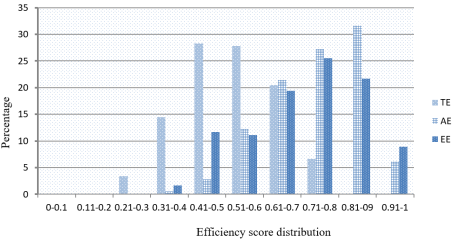
The distribution of economic efficiency scores implies that 25.55% of the household heads have an economic efficiency score of 71 to 80%. (Figure 1).
Source: Survey result, 2023

Download: Download full-size image

Figure 1. Frequency distribution and estimates of efficiencies.
3.5. Determinants of Efficiency Differentials Among Farmers
The results of Tobit regression model showed that land allotted to onion production, credit utilization and distance to the FTC were important factors affecting Technical efficiency. It also revealed that onion production experience, land allotted to onion production, pilot distance, distance to the market, having own motor pump, family size and extension contact were significantly affecting allocative efficiency. Besides, Family size, pilot distance, credit utilization and extension contact were significantly affecting economic efficiency of onion production.
Table 10. Tobit model estimates for different efficiency measures.

Variables

TE

AE

EE

coefficient

Std.error

coefficient

Std.error

Coefficient

Std.error

Age of HH

0.001

0.001

0.00098

0.0014

0.0017

0.0010

Onion production experience

0.0024

0.002

-0.000026***

0.0023

0.0019

0.0018

Family size in AER

-0.004

0.005

-0.0105

0.006

0.009***

0.0049

Education of HH

-0.0007

0.003

-0.0024

0.003

-0.0016

0.0025

TLU

-0.0052

0.004

0.004417

0.0043

0.00018

0.0033

Land allotted to onion

0.097**

0.048

-0.117**

0.058

-0.012

0.046

Plot distance

-0.0006

0.00097

-0.0019***

0.0012

-0.00187**

0.00092

Distance to the nearest market

0.0003

0.00021

-0.00062**

0.00026

-0.00028

0.0002

Having Motor pump

-0.027

0.023

0.0552***

0.0284

0.02095

0.0223

Credit utilization

0.055**

0.026

-0.0095

0.031

0.0408***

0.0245

Distance to FTC

-0.002**

0.00056

-0.00084

0.00068

-0.00156*

0.0005

Extension contact

-0.021

0.019

0.0640*

0.024

0.0335**

0.019

Cons

0.0701*

0.051

0.779*

0.062

0.537*

0.048

Note: *, ** and *** refers to 10%, 5% and 1% significance level, respectively.
Source: model result, 2023
3.6. Discussions
The mean TE onion of sample farmers was about 0.74 with a minimum level of 0.33 and the maximum level of 0.94. The mean of TE indicates that, if sample households operated at full efficiency level they would increase their output by 26% using the existing resources and level of technology. The average AE of the sample farmers was about 0.71 with a minimum of 0.32 and a maximum of 0.97. This shows that farmers are not allocative efficient in producing onion under irrigation, which implies that the production, on average, is about 29% below the frontier (less than the achievable potential output). This means that more inputs are being allocated for given levels of output produced. Distribution of the technical efficiency scores showed that about 28.33% of the sample households had technical efficiency score of 41 to 50%. The allocative efficiency distribution scores indicated that about 31.66% of onion producers operated above 81 to 90% efficiency level.
Onion production experience: expectedly, experience in onion irrigation production was found to have a negative and significant effect on allocative efficiency. The reason might be due to those farmers who are more experienced in onion farming under irrigation are more conservative to adopt new technology rather they prefer to remain with traditional production system and they are less likely to be market oriented under current production system. This finding was conformity with that of .
Family size: The coefficient of family size has a positive and significant effect on economic efficiency at 1% probability levels. The possible reason for this result might be that a larger household size guarantees availability of family labor for farm operations to be accomplished in time. At the time of peak seasons, there is a shortage of labor and hence household with large family size would deploy more labor to undertake the necessary farming activities like, weeding and harvesting on time than their counterparts and hence they are efficient in onion production. this finding was confirmed with that of The result by Aye and Mungatana .
Land allotted to onion: Land for Onion sample farmers in Onion farming had positive relationship with Technical and negative Economic efficiency as prior expectation significantly at 10% significance level. The reason might be due to farmers who have large farm is more likely to employ improved agricultural technologies, used as a capital base and enhances the risk bearing ability of farmers and hence could be more technical efficient than small farms due to its advantage of the economic scale and it incur more transaction costs than small land size. The result in line with Denkoh et al. (2013), Rajendran et al. (2015) and Hussein, 2007.
Plot distance: distance of irrigated onion farm from the home of household head was negatively and significant effect on both allocative and economic efficiencies at 1% and 5% probability level respectively. This might be due to, the sample household that near onion irrigation farm were delivery input timely, reduces transport cost of inputs and easily disposal of output compared to household who has far plot distance from their home. This result was consistent with .
Distance to the nearest market: Distance to farmers from the nearest market had negative relationship with allocative efficiency as prior expectation significantly at 1% significance level. This implies that having higher distance between their residence and marketplace reduces their allocative efficiency in onion production due to large distance increases transaction cost of inputs. The result is confirmed with Adino .
Credit utilization: The credit utilization had a positive and significant effect on both TE and EE at 5% and 1% significance level respectively. It is an important element in agricultural production systems. Credit availability shifts the cash constraint outwards and enables farmers to make timely purchases inputs.
Distance to FTC: Distance to farmers from Farmers Training Center of farmers had negative relationship with Technical and Economic efficiency as prior expectation significantly at 5% and 10% significance level respectively. This implies the farmers nearby Farmers training Centers (FTC) get more information on know how to use new technologies and better management to improve their technical efficiency and economic efficiency. This is in line with the findings of Desale (2017).
Extension contact: Extension contact has significant and positive effect on allocative and economic efficiencies at 10% and 5% probability level respectively. This implies that a household who contacted with extension agent during the irrigation period were allocativelly and economically more efficient than those household not contacted with extension agents. Meaning that, a household who contacted with extension agent have ability to allocate input bundle or produce a given level of output in the cost minimizing way and more capable of producing predetermined quantity of onion output at minimum cost for a given level of technology. This finding was in agreement with the result obtained by .
Conclusions: Onion is produced in home gardens and commercially in different parts of the Ethiopia and has a significant contribution to the producers as food and source income in selected districts. The area under onion cultivation is increasing mainly due to expansion of small-scale irrigation. Despite increased production area for onion with irrigation; its productivity is lower. Therefore, the analysis of technical, allocative and economic efficiency of onion farming with irrigation is important. The overall objective of this study was to examine producers’ technical, allocative and economic efficiencies onion under irrigation in west shewa zone of Oromia region, Ethiopia.
To conduct the study, primary data were collected from 180 randomly selected household heads through semi-structured questionnaire. In terms of methodology, the Cobb-Douglas specification of the model was used. Result of the production function indicated that land, seed, chemicals, labor and oxen were the significant inputs, with positive sign as expected The study indicated that the mean levels of TE, AE and EE onion production under irrigation found to be 74%, 71% and 52% respectively. This implied onion producer under irrigation in the study area are not operating at full technical, allocative and economic efficiency levels. The result of Tobit model revealed that, out of total 12 explanatory variables included in the model, Onion production experience, Family size in AER, plot distance, Distance to the nearest market, Having Motor pump, Credit utilization were found to be statistically significant to affect the level of Onion production efficiency under irrigation. Land, seed, chemicals are under-utilized but labor and oxen power are over utilized. The responsible bodies should be improving technical knowledge among the farmers to use the available existing resources efficiently. Extension contact has significant and positive effect on economic efficiency. Therefore, the policies should place strengthening the existing agricultural extension service through providing incentives, short and long-term training, and providing non-overlapping responsibilities to extension workers. Access to credit has a significant effect on both allocative and economic efficiency positively. Therefore, responsible bodies should be increases access to credit services for smallholder farmers and make strong r/ship farmers and MFI to help farmers to acquire inputs. Experience of onion farming under irrigation has significant and negative effect on Allocative efficiency. Therefore, district agricultural office, should be encourage experienced farmers to shift from traditional to modern production technologies. Having motor pump was found to have positive and significant effect on AE. Therefore, district irrigation authority should search a means how to onion farmers obtain motor pump and distributing existing pump is an option.
Abbreviations

FAO

Food and Agricultural Organization

WFP

World Food Programme

SFA

Stochastic Frontier

HH

Household

AER

Adult Equilivent Ratio

FTC

Farmer Training Center

EE

Economic Efficiency

AE

Allocative Efficiency

TE

Technical Efficiency

Acknowledgments
Authors acknowledge the funds provided by Higher Education Commission of Pakistan.
Author Contributions
Sheleme Refera: Conceptualization, Data curation, Formal Analysis, Methodology, Project administration, Software, Writing - original draft, Writing - review & editing
Gemechisa Yadeta: Investigation, Supervision, Validation
Conflicts of Interest
The authors declare no conflicts of interest.
4. References
[1] Aklilu Nigussie, Yitagesu Kuma, Abiy Adisu, Tigist Alemu and Kidane Desalegn. 2015. Onion production for income generation in small scale irrigation users agropastoral households of Ethiopia. Journal of Horticulture, 1-5.
[2] Akinbode, S. O., Dipeolu, A. O and Ayinde, I. A. 2011. An Examination of Technical, Allocative and Economic Efficiencies in Ofada Rice Farming on Ogun State, Nigeria. African Journal of Agricultural Research, 6(28): 6027-6035.
[3] Adino Andaregie 2020. Determinants of technical efficiency of potato farmers and effects of constraints on potato production in Northern Ethiopia.
[4] Aye, G. C. and Mungatana, E. D. 2011. Technological Innovation and Efficiency in the Nigerian Maize Sector: Parametric Stochastic and Non-parametric Distance Function Approaches, Agrekon: Agricultural Economics Research, Policy and Practice in Southern Africa, 50(4): 1-24.
[5] Haregu Gebrezgabher 2015. Efficiency of male and female as irrigated onion growers.
[6] Awol Ahmed. 2014. Economic Efficiency of Rain-fed Wheat producing Farmers in North Eastern Ethiopia: The case of Albuko District. M. Sc. Thesis Presented to the School of Graduate Studies of Haramaya University.
[7] CSA (Central Statically Agency).2019. Area and production of major crops on private peasant holdings, Meher Season in Ethiopia. Volume I.
[8] CSA (Central Statistical Agency). 2015. Agricultural sample survey of Ethiopia. Report on area and production of major cops. Addis Ababa, Ethiopia.
[9] Ermiyas Mekonnen, Endrias Geta and Belaineh Legesse. 2015. Economic Efficiency of Sesame Production in Selamago District of South Omo Zone, Southern Ethiopia. JournalofAgriculturalSciences, 2(1): 8-21.
[10] Essa Chanie, Gideon A. Obare, Ayalneh Bogale, and Franklin P. 2012. Resource Use Efficiency of Smallholder Crop Production in the Central Highlands of Ethiopia.
[11] Food and Agricultural Orgization, World Food Organization 2012; Livelihood Asset.
[12] Greene, W. H. (2003). Econometric Analysis. 5th edition. Pearson education, Inc., Upper Saddle River, New Jersey.
[13] Meftu Abdi, 2016. Economic Efficiency of Groundnut: The Case of Gursum District, East Hararghe Zone, Oromia National Regional State, Ethiopia.
References
[1] Aklilu Nigussie, Yitagesu Kuma, Abiy Adisu, Tigist Alemu and Kidane Desalegn. 2015. Onion production for income generation in small scale irrigation users agropastoral households of Ethiopia. Journal of Horticulture, 1-5.
[2] Akinbode, S. O., Dipeolu, A. O and Ayinde, I. A. 2011. An Examination of Technical, Allocative and Economic Efficiencies in Ofada Rice Farming on Ogun State, Nigeria. African Journal of Agricultural Research, 6(28): 6027-6035.
[3] Adino Andaregie 2020. Determinants of technical efficiency of potato farmers and effects of constraints on potato production in Northern Ethiopia.
[4] Aye, G. C. and Mungatana, E. D. 2011. Technological Innovation and Efficiency in the Nigerian Maize Sector: Parametric Stochastic and Non-parametric Distance Function Approaches, Agrekon: Agricultural Economics Research, Policy and Practice in Southern Africa, 50(4): 1-24.
[5] Haregu Gebrezgabher 2015. Efficiency of male and female as irrigated onion growers.
[6] Awol Ahmed. 2014. Economic Efficiency of Rain-fed Wheat producing Farmers in North Eastern Ethiopia: The case of Albuko District. M. Sc. Thesis Presented to the School of Graduate Studies of Haramaya University.
[7] CSA (Central Statically Agency).2019. Area and production of major crops on private peasant holdings, Meher Season in Ethiopia. Volume I.
[8] CSA (Central Statistical Agency). 2015. Agricultural sample survey of Ethiopia. Report on area and production of major cops. Addis Ababa, Ethiopia.
[9] Ermiyas Mekonnen, Endrias Geta and Belaineh Legesse. 2015. Economic Efficiency of Sesame Production in Selamago District of South Omo Zone, Southern Ethiopia. JournalofAgriculturalSciences, 2(1): 8-21.
[10] Essa Chanie, Gideon A. Obare, Ayalneh Bogale, and Franklin P. 2012. Resource Use Efficiency of Smallholder Crop Production in the Central Highlands of Ethiopia.
[11] Food and Agricultural Orgization, World Food Organization 2012; Livelihood Asset.
[12] Greene, W. H. (2003). Econometric Analysis. 5th edition. Pearson education, Inc., Upper Saddle River, New Jersey.
[13] Meftu Abdi, 2016. Economic Efficiency of Groundnut: The Case of Gursum District, East Hararghe Zone, Oromia National Regional State, Ethiopia.
Cite This Article
  • APA Style

    Refera, S., Yadeta, G. (2025). Analysis of Economic Efficiency of Onion Production Under Irrigation in West Shewa Zone, Oromia, Ethiopia. Science Research, 13(4), 101-111. https://doi.org/10.11648/j.sr.20251304.16

    Copy | Download

    ACS Style

    Refera, S.; Yadeta, G. Analysis of Economic Efficiency of Onion Production Under Irrigation in West Shewa Zone, Oromia, Ethiopia. Sci. Res. 2025, 13(4), 101-111. doi: 10.11648/j.sr.20251304.16

    Copy | Download

    AMA Style

    Refera S, Yadeta G. Analysis of Economic Efficiency of Onion Production Under Irrigation in West Shewa Zone, Oromia, Ethiopia. Sci Res. 2025;13(4):101-111. doi: 10.11648/j.sr.20251304.16

    Copy | Download

  • @article{10.11648/j.sr.20251304.16,
      author = {Sheleme Refera and Gemechisa Yadeta},
      title = {Analysis of Economic Efficiency of Onion Production Under Irrigation in West Shewa Zone, Oromia, Ethiopia
    },
      journal = {Science Research},
      volume = {13},
      number = {4},
      pages = {101-111},
      doi = {10.11648/j.sr.20251304.16},
      url = {https://doi.org/10.11648/j.sr.20251304.16},
      eprint = {https://article.sciencepublishinggroup.com/pdf/10.11648.j.sr.20251304.16},
      abstract = {The study was measures efficiencies of Onion Producers under irrigation and identify factors affecting them in in West Shewa Zone, Oromia, Ethiopia. Stochastic production frontier model was used to estimate technical, allocative and economic efficiency levels, whereas Tobit model was used to identify factors affecting efficiency levels. Accordingly, the mean technical, allocative and economic efficiencies of sample households were 74%, 70% and 52%, respectively. Land, seed, herbicide and insecticide, labor and oxen power were positively affected the production of onion. Although, land, seed, herbicide and insecticide were underutilized inputs but labor and oxen power were over-utilized inputs. Results of the Tobit model revealed that land allotted to onion production and credit utilization was affected technical efficiency positively but distance to the FTC was affected technical efficiency negatively. It also revealed that onion production experience, land allotted to onion production, pilot distance, distance to the market were affected allocative efficiency negatively but having own motor pump and extension contact were affected allocative efficiency positively. Besides, Family size, credit utilization and extension contact were positively affected economic efficiency of onion production but pilot distance and distance to the FTC were negatively affected economic efficiency of onion production. Results indicate that there is an opportunity to increase efficiency of onion production under irrigation in the study area. Therefore, zonal and district office of agriculture, stockholders and concerned bodies should focus above mentioned factors to improve the productivity of onion under irrigation.},
     year = {2025}
    }
    

    Copy | Download

  • TY  - JOUR
    T1  - Analysis of Economic Efficiency of Onion Production Under Irrigation in West Shewa Zone, Oromia, Ethiopia
    
    AU  - Sheleme Refera
    AU  - Gemechisa Yadeta
    Y1  - 2025/08/18
    PY  - 2025
    N1  - https://doi.org/10.11648/j.sr.20251304.16
    DO  - 10.11648/j.sr.20251304.16
    T2  - Science Research
    JF  - Science Research
    JO  - Science Research
    SP  - 101
    EP  - 111
    PB  - Science Publishing Group
    SN  - 2329-0927
    UR  - https://doi.org/10.11648/j.sr.20251304.16
    AB  - The study was measures efficiencies of Onion Producers under irrigation and identify factors affecting them in in West Shewa Zone, Oromia, Ethiopia. Stochastic production frontier model was used to estimate technical, allocative and economic efficiency levels, whereas Tobit model was used to identify factors affecting efficiency levels. Accordingly, the mean technical, allocative and economic efficiencies of sample households were 74%, 70% and 52%, respectively. Land, seed, herbicide and insecticide, labor and oxen power were positively affected the production of onion. Although, land, seed, herbicide and insecticide were underutilized inputs but labor and oxen power were over-utilized inputs. Results of the Tobit model revealed that land allotted to onion production and credit utilization was affected technical efficiency positively but distance to the FTC was affected technical efficiency negatively. It also revealed that onion production experience, land allotted to onion production, pilot distance, distance to the market were affected allocative efficiency negatively but having own motor pump and extension contact were affected allocative efficiency positively. Besides, Family size, credit utilization and extension contact were positively affected economic efficiency of onion production but pilot distance and distance to the FTC were negatively affected economic efficiency of onion production. Results indicate that there is an opportunity to increase efficiency of onion production under irrigation in the study area. Therefore, zonal and district office of agriculture, stockholders and concerned bodies should focus above mentioned factors to improve the productivity of onion under irrigation.
    VL  - 13
    IS  - 4
    ER  - 

    Copy | Download

Author Information
  • Abstract
  • Keywords
  • Document Sections

    1. 1. Introduction
    2. 2. Research Methodology
    3. 3. Results
    4. 8. References
    Show Full Outline
  • Abbreviations
  • Acknowledgments
  • Author Contributions
  • Conflicts of Interest
  • References
  • Cite This Article
  • Author Information